
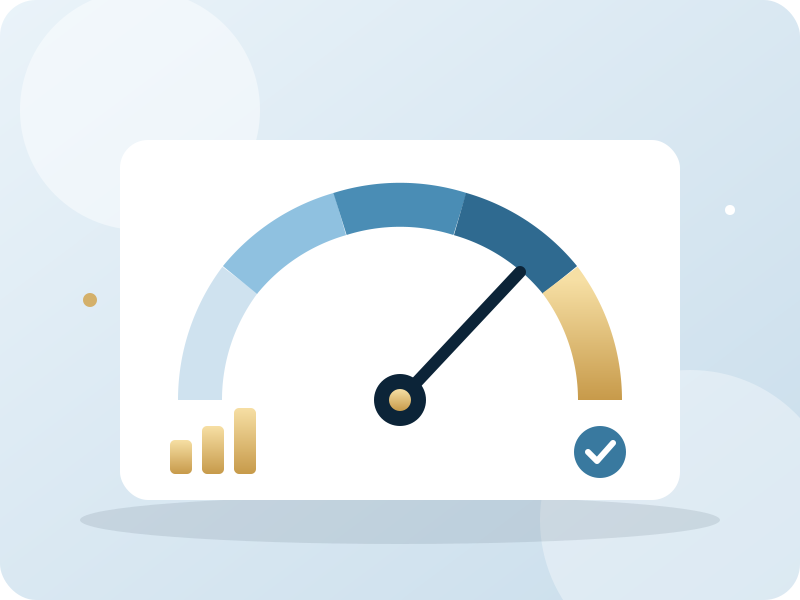
Before a bank looks at your income or your property, it looks at your credit report. A healthy score does not guarantee a loan, but a weak one can narrow your choices. The good news is that most of what drives a score is within your control.
- In India a CIBIL score runs from 300 to 900, and higher is better. Many lenders look for 700 or more, and partner banks for home loans generally expect 700+.
- Paying every EMI and card bill on time matters more than anything else.
- Check your report early, because errors can be corrected, but corrections take time.
- There is no overnight fix. Steady habits show up over a few months.
What a credit score actually is
A credit score is a three-digit number that summarises how you have handled borrowing in the past. It is calculated by credit bureaus such as TransUnion CIBIL, Experian, Equifax and CRIF High Mark, using the information that banks and lenders report to them every month.
The CIBIL score, the one most Indian lenders mention first, ranges from 300 to 900. Lenders set their own cut-offs, so there is no single number that works everywhere, but a score of 700 and above is widely treated as the comfortable zone.
What moves your score up or down
Five things carry most of the weight.
- Payment history: whether you paid EMIs and card bills on time. Even a few late payments can hurt, and they stay on your report for years.
- Credit utilisation: how much of your card limit you use. Staying well below the limit, commonly suggested as under 30%, signals that you are not stretched.
- Length of credit history: older, well-kept accounts help. Closing your oldest card without need can shorten your history.
- Credit mix: a healthy blend of secured loans (home, vehicle) and unsecured credit (cards, personal loans) looks better than only one kind.
- New enquiries: every loan or card application leaves a hard enquiry. Many applications in a short time can look like financial stress.
A practical plan, step by step
If you plan to apply for a loan in the next few months, start with these steps.
- Get your report. Under RBI rules you can ask each credit bureau for one free full credit report every year. Read it line by line.
- Fix mistakes. If an account is not yours, or a paid loan still shows as overdue, raise a dispute with the bureau and the lender. Keep the proof of payment.
- Clear overdue amounts first. Lenders look closely at accounts marked overdue, settled or written off, and these hurt the most.
- Switch on auto-pay for EMIs and at least the minimum due on cards, so a missed date never costs you.
- Bring card use down. Pay balances before the statement date if you can, and spread spending across cards instead of maxing one.
- Pause new applications. Avoid applying for new cards or loans for a few months before your main application.
- Keep old accounts open and in good standing unless there is a real reason to close them.
How long does it take?
Scores update when lenders report to the bureaus, usually monthly. Fixing a wrong entry can show up within a few weeks once the lender corrects it. Building a stronger record through on-time payments and lower card use generally takes a few months, and the more serious the earlier problem, the longer it takes.
Be careful with anyone who promises to raise your score quickly for a fee. A real score only changes when your reported behaviour changes.
When to check, and what to do if your score is low
Check your score two to three months before you apply, so there is time to correct errors and build a better record. If you are close to a lender's cut-off, a short wait can open more options.
If your score is lower than you would like, that does not always mean no loan. Different lenders have different policies, and some products rely more on income, collateral or business cash flow. An adviser can look at your profile and tell you which options are realistic, and what to improve first.
This article is general information, not financial, legal or tax advice. Figures and examples are illustrative. Finexa Capital (Priyanka Enterprise) is a loan referral partner (DSA). Final approval, interest rate and terms are decided solely by the lending bank or NBFC.